# Preview

https://github.com/user-attachments/assets/3fe3ac8f-c938-4df4-9afe-11980046944d

# Details

- Group pms by `last_posted_at`. In this first iteration we are group by `7 days`, `30 days`, then by month beyond that.
- I inject a sidebar section link with the relative (last_posted_at) date and then update a tracked value to ensure we don't do it again. Then for each month beyond the first 30days, I add a value to the `loadedMonthLabels` set and we reference that (plus the year) to see if we need to load a new month label.
- I took the creative liberty to remove the `Conversations` section label - this had no purpose
- I hid the _collapse all sidebar sections_ carrot. This had no purpose.
- Swap `BasicTopicSerializer` to `ListableTopicSerializer` to get access to `last_posted_at`
In the last commit, I introduced a topic_custom_field to determine if a PM is indeed a bot PM.

This commit adds a migration to backfill any PM that is between 1 real user, and 1 bot. The correct topic_custom_field is added for these, so they will appear on the bot conversation sidebar properly.

We can also drop the joining to topic_users in the controller for sidebar conversations, and the isPostFromAiBot logic from the sidebar.
Overview
This PR introduces a Bot Homepage that was first introduced at https://ask.discourse.org/.

Key Features:
Add a bot homepage: /discourse-ai/ai-bot/conversations
Display a sidebar with previous bot conversations
Infinite scroll for large counts
Sidebar still visible when navigation mode is header_dropdown
Sidebar visible on homepage and bot PM show view
Add New Question button to the bottom of sidebar on bot PM show view
Add persona picker to homepage
In this feature update, we add the UI for the ability to easily configure persona backed AI-features. The feature will still be hidden until structured responses are complete.
This update adds the ability to disable search discoveries. This can be done through a tooltip when search discoveries are shown. It can also be done in the AI user preferences, which has also been updated to accommodate more than just the one image caption setting.
**This PR includes a variety of updates to the Sentiment Analysis report:**
- [X] Conditionally showing sentiment reports based on `sentiment_enabled` setting
- [X] Sentiment reports should only be visible in sidebar if data is in the reports
- [X] Fix infinite loading of posts in drill down
- [x] Fix markdown emojis showing not showing as emoji representation
- [x] Drill down of posts should have URL
- [x] ~~Different doughnut sizing based on post count~~ [reverting and will address in follow-up (see: `/t/146786/47`)]
- [X] Hide non-functional export button
- [X] Sticky drill down filter nav
## 🔍 Overview
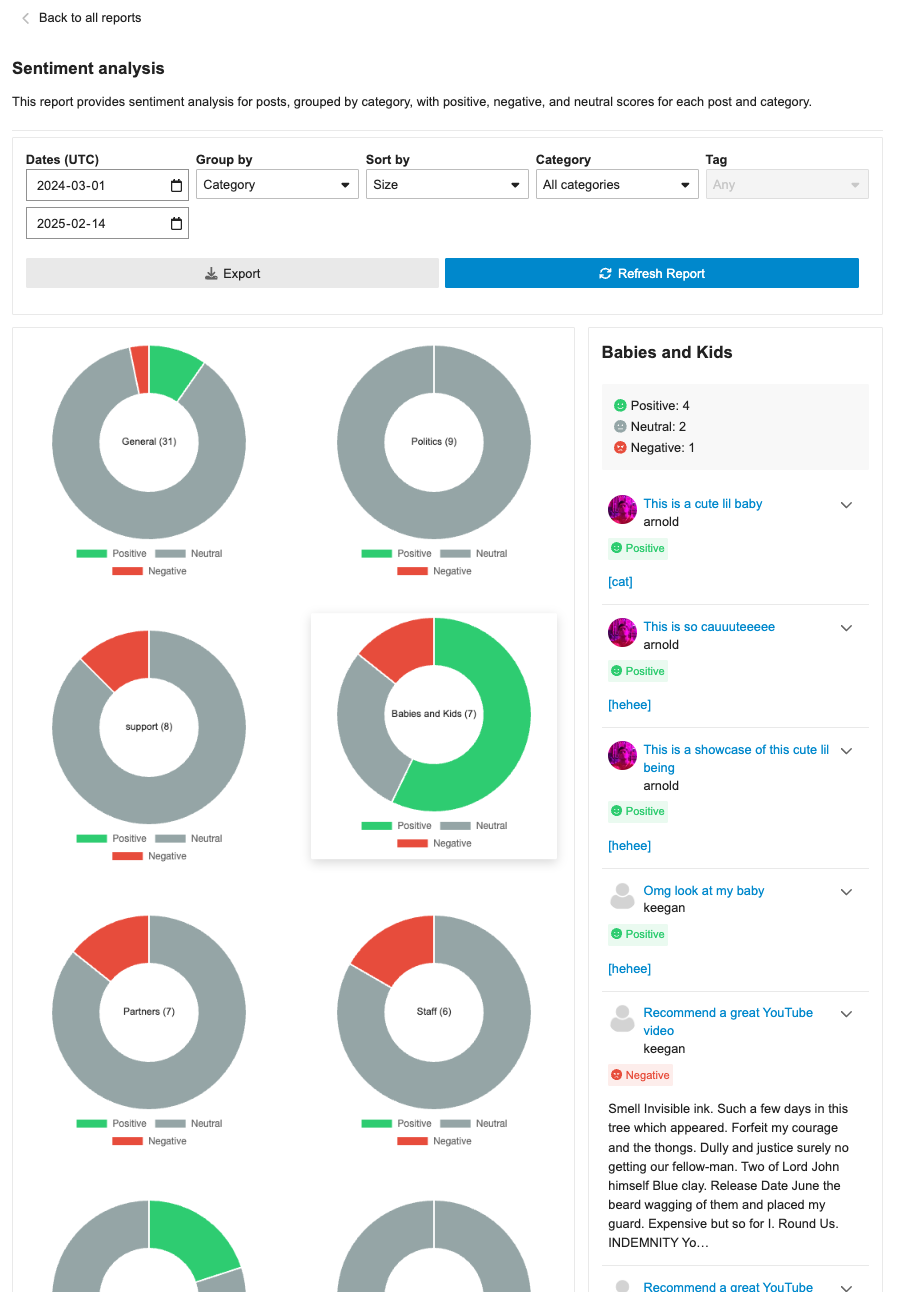
This update adds a new report page at `admin/reports/sentiment_analysis` where admins can see a sentiment analysis report for the forum grouped by either category or tags.
## ➕ More details
The report can breakdown either category or tags into positive/negative/neutral sentiments based on the grouping (category/tag). Clicking on the doughnut visualization will bring up a post list of all the posts that were involved in that classification with further sentiment classifications by post.
The report can additionally be sorted in alphabetical order or by size, as well as be filtered by either category/tag based on the grouping.
## 👨🏽💻 Technical Details
The new admin report is registered via the pluginAPi with `api.registerReportModeComponent` to register the custom sentiment doughnut report. However, when each doughnut visualization is clicked, a new endpoint found at: `/discourse-ai/sentiment/posts` is fetched to showcase posts classified by sentiments based on the respective params.
## 📸 Screenshots
We have removed this flag in core. All plugins now use the "top mode" for their navigation. A backwards-compatible change has been made in core while we remove the usage from plugins.
* Use AR model for embeddings features

* endpoints

* Embeddings CRUD UI

* Add presets. Hide a couple more settings

* system specs

* Seed embedding definition from old settings

* Generate search bit index on the fly. cleanup orphaned data

* support for seeded models

* Fix run test for new embedding

* fix selected model not set correctly
Adds a comprehensive quota management system for LLM models that allows:

- Setting per-group (applied per user in the group) token and usage limits with configurable durations
- Tracking and enforcing token/usage limits across user groups
- Quota reset periods (hourly, daily, weekly, or custom)
-  Admin UI for managing quotas with real-time updates

This system provides granular control over LLM API usage by allowing admins
to define limits on both total tokens and number of requests per group.
Supports multiple concurrent quotas per model and automatically handles
quota resets.


Co-authored-by: Keegan George <[email protected]>
This introduces a comprehensive spam detection system that uses LLM models
to automatically identify and flag potential spam posts. The system is
designed to be both powerful and configurable while preventing false positives.

Key Features:
* Automatically scans first 3 posts from new users (TL0/TL1)
* Creates dedicated AI flagging user to distinguish from system flags
* Tracks false positives/negatives for quality monitoring
* Supports custom instructions to fine-tune detection
* Includes test interface for trying detection on any post

Technical Implementation:
* New database tables:
  - ai_spam_logs: Stores scan history and results
  - ai_moderation_settings: Stores LLM config and custom instructions
* Rate limiting and safeguards:
  - Minimum 10-minute delay between rescans
  - Only scans significant edits (>10 char difference)
  - Maximum 3 scans per post
  - 24-hour maximum age for scannable posts
* Admin UI features:
  - Real-time testing capabilities
  - 7-day statistics dashboard
  - Configurable LLM model selection
  - Custom instruction support

Security and Performance:
* Respects trust levels - only scans TL0/TL1 users
* Skips private messages entirely
* Stops scanning users after 3 successful public posts
* Includes comprehensive test coverage
* Maintains audit log of all scan attempts


---------

Co-authored-by: Keegan George <[email protected]>
Co-authored-by: Martin Brennan <[email protected]>
Add support for versioned artifacts with improved diff handling

* Add versioned artifacts support allowing artifacts to be updated and tracked
  - New `ai_artifact_versions` table to store version history
  - Support for updating artifacts through a new `UpdateArtifact` tool
  - Add version-aware artifact rendering in posts
  - Include change descriptions for version tracking

* Enhance artifact rendering and security
  - Add support for module-type scripts and external JS dependencies
  - Expand CSP to allow trusted CDN sources (unpkg, cdnjs, jsdelivr, googleapis)
  - Improve JavaScript handling in artifacts

* Implement robust diff handling system (this is dormant but ready to use once LLMs catch up)
  - Add new DiffUtils module for applying changes to artifacts
  - Support for unified diff format with multiple hunks
  - Intelligent handling of whitespace and line endings
  - Comprehensive error handling for diff operations

* Update routes and UI components
  - Add versioned artifact routes
  - Update markdown processing for versioned artifacts

Also

- Tweaks summary prompt
- Improves upload support in custom tool to also provide urls
- Added a new admin interface to track AI usage metrics, including tokens, features, and models.
- Introduced a new route `/admin/plugins/discourse-ai/ai-usage` and supporting API endpoint in `AiUsageController`.
- Implemented `AiUsageSerializer` for structuring AI usage data.
- Integrated CSS stylings for charts and tables under `stylesheets/modules/llms/common/usage.scss`.
- Enhanced backend with `AiApiAuditLog` model changes: added `cached_tokens` column  (implemented with OpenAI for now) with relevant DB migration and indexing.
- Created `Report` module for efficient aggregation and filtering of AI usage metrics.
- Updated AI Bot title generation logic to log correctly to user vs bot
- Extended test coverage for the new tracking features, ensuring data consistency and access controls.
 Sérgio Saquetim
 Mark VanLandingham
 Isaac Janzen
 Kris
 Keegan George
 Jarek Radosz
 Martin Brennan
 David Taylor
 Ted Johansson
 Roman Rizzi
 Kelv
 SamandKeegan George
 Rafael dos Santos Silva